
Four Hamilton County Property Value Layers
Start with the Hamilton County Property Reports page, which breaks value components and tax calculations into separate lines. Check the labels and year on every figure before you set it beside a deed or sale disclosure.
| Value | What It Is | Where |
|---|---|---|
| Gross assessed value | Administrative value before deductions, divided among land and improvements | Property Record Card and Property Reports |
| Net assessed value | Gross assessed value after qualifying deductions, used in the tax calculation | Property Reports and tax statement |
| Sale value | Reported consideration and transfer facts, which may involve unusual terms or multiple parcels | Sales Disclosure and recorded instrument |
| Market opinion | A date-specific private appraisal, broker analysis, or listing estimate | Outside the county assessment roll |
Indiana treats assessed value as true tax value at a 100% assessment level. The working ratio is assessed value divided by sale price. It is described by the Department of Local Government Finance. That ratio is a statewide average. One parcel's assessment can still miss its latest sale price. The sale may be atypical, or fall outside the study window. It may include items that are not real estate.
Read Land, Improvements, Gross, and Net AV
For the assessment itself, the Property Record Card is the best evidence packet. Save its land and improvement components, property class, neighborhood, acreage, building characteristics, deductions, assessment date, and tax year. Gross AV is the assessed total before deductions. Net AV comes after deductions. It is the figure that feeds the liability calculation. The public report goes further, breaking out tax rate, gross liability, local credits, property-tax cap savings, senior cap savings, and total liability. Other Assessments may carry drainage, weed, sewage, Barrett Law, or unsafe-building charges. Those amounts sit on the statement. They are not extra market-value estimates. Note: A tax bill stacks several arithmetic layers, and calling them all "property value" invites false comparisons.
The official Hamilton County report portal is the source for the assessment field layout.
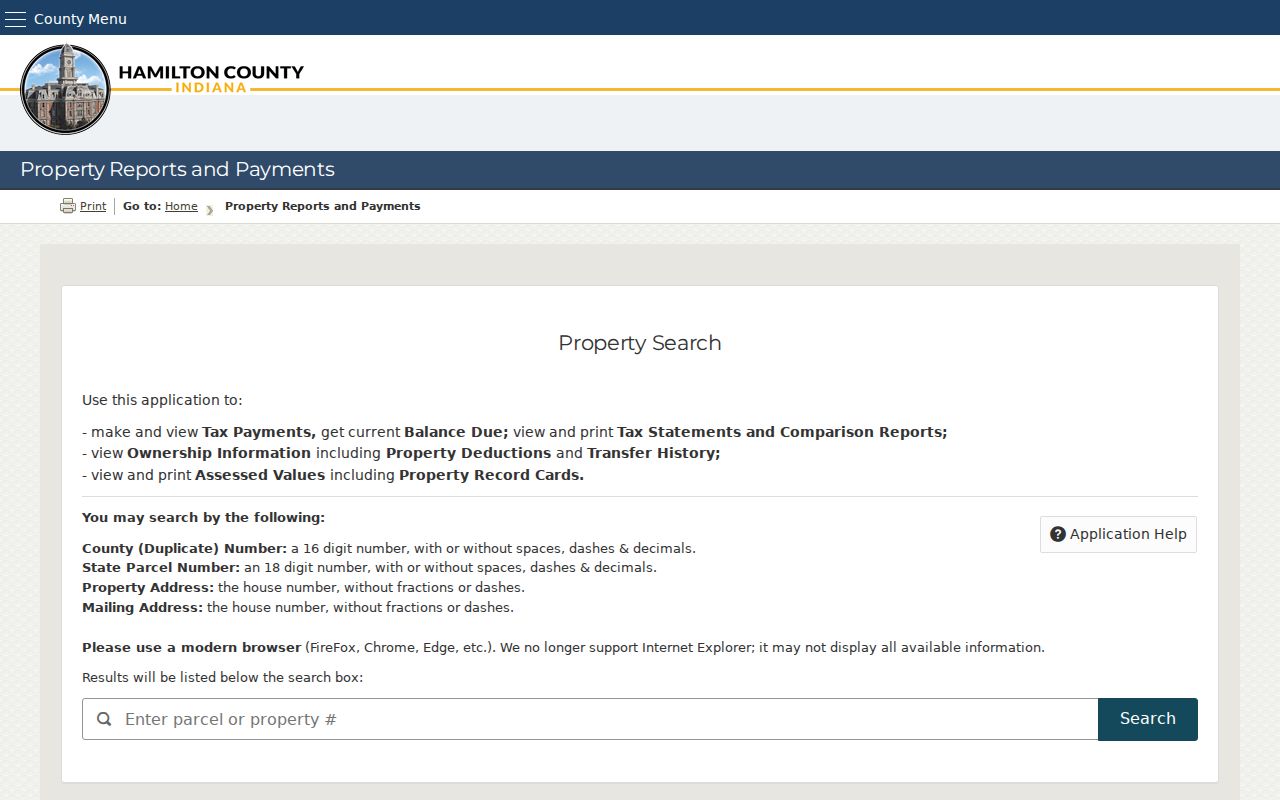
The Property Reports page shows the official lookup route for any Hamilton County parcel. Use the returned card's tax year and component labels when you build an actual comparison.
Hamilton County Uses a Prior-Year Sales Study
Assessment, general reassessment, and uniformity sit with the Hamilton County Assessor. So do sales disclosures, omitted property, appeals, and recent land-sale base rates. The county sets the assessment date at January 1, 2026. It draws on sales from January 1 through December 31, 2025. Set that window beside the parcel's own sale date. Only then ask whether the sale shaped the current assessment. Annual adjustment is mass appraisal, not a parcel-by-parcel repricing. A physical change can move value on its own. So can a classification correction, neighborhood model, new construction, demolition, split, combination, or replat. No arm's-length sale is needed for any of them. And a new sale does not automatically become the assessed amount.
Look Up a Hamilton County Property Value
Pull the official value-of-record with an address or parcel number. Then save the retrieval date and source for every comparison you make.
- Search Property Reports by county duplicate number, state parcel number, property address, or mailing address. Partial addresses work.
- Open the Property Record Card and record land AV, improvement AV, gross AV, deductions, net AV, class, neighborhood, and year.
- Read Transfer History and the latest Sales Disclosure or recorded instrument for the sale and recording dates.
- Note physical changes, permits, acreage, taxing unit, and whether the sale fell inside the assessment study window.
- Compare like property classes and dates; do not mix a corrected current balance with an older statement as mailed.
- Assessed value
- The administrative true tax value used in Indiana's property-tax system.
- Market value-in-use
- The value of property for its current use within Indiana's assessment framework.
- Assessment level
- The overall relationship of assessed value to market value; Indiana's stated level is 100%.
- Sale price
- The consideration for a particular transfer, subject to that transaction's terms and disclosures.
Sales Disclosure Is Evidence, Not an Automatic Answer
Indiana's Sales Disclosure form captures the parcel number, land and improvement AV, total AV, property class, neighborhood code, tax district, acreage, and transfer value. It also captures physical changes between assessment and sale. The Auditor portion logs transfer processing and fees. The receipt names the buyer shown on the conveyance. It may also flag possible deductions. A reported transaction can still be non-arm's-length, span multiple parcels, or include personal property. It may also need correction later. Compare the disclosure against the latest deed through the Recorder's recorded-document route. The deed gives recorded transfer context, never a current appraisal.
Dates Explain Many Hamilton County Value Differences
Property Reports displays three assessment years and links to a Property Record Card. Tax Statements stay online for three years as mailed, with no later corrections applied. Payment Details may be fresher. Current Ownership and Transfer History update five times weekly, the county says. Record the retrieval date, assessment date, sale date, recorded date, and tax year for every figure you keep. A fresh transfer can reach the Recorder before the assessment and map fields catch up. Under the county's current workflow, new documents are generally viewable online within about a day. No official source promises one fixed closing-to-roll lag, though. For a recent sale, check both systems and label their dates.
Build an Evidence File Before Challenging Value
The assessment route and the tax-payment route are not the same road. The Assessor reviews value and classification. The Auditor keeps the tax roll and deductions. The Treasurer collects what was billed. A deed or legal-description correction instead follows the Recorder and Real Property sequence. Hamilton County mails Form 11 notices by April 30. The current 2026 appeal page lists a June 15 deadline. It also lists an online Form 130 route, and power-of-attorney requirements. Keep Form 11, the Property Record Card, and comparable sales in one file. Add photographs, measurements, permits, and physical-change evidence to it. Confirm this year's deadline on the Assessment Appeal Process page instead of trusting an old calendar.
Physical Changes and Plats Can Shift the Comparison
New construction, demolition, a lot split, replat, annexation, or a use change can quietly change a parcel. That can make an earlier comparison worthless. The parcel card's building and acreage fields explain the break. So can the county GIS export date. The Sales Disclosure physical-change field and the city permit record can explain it too. A permit adds context. It is not itself an assessment. When a parcel number changes, the parent and child legal descriptions need reconciling. Use the county plat layer and the Recorder for that. Matching a new parcel's AV against the undivided parent is not a valid trend. That match ignores acreage and improvements.
Make Every Hamilton County Value Comparison Reproducible
Write down what you pulled and where it came from. That means the county parcel number and state parcel number. Add the source URL, the retrieval date, the assessment date, and the tax year. Log the gross assessed value, every deduction, and the net assessed value. Note the land and improvement split and the property class. Include the neighborhood, the acreage, and the basic building facts. Sale comparisons need a few more fields. List the sale date, recording date, disclosure status, parcel count, and any reported physical change. A private opinion of value calls for its effective date and scope as well.
Say plainly what you are comparing. The ratio-study check divides assessed value by sale price. But that arithmetic cannot tell you whether a sale was representative. It also cannot say whether a classification or physical-change problem lurks underneath. A clean comparison card puts those limits on the table. It also stops anyone from casually dividing a newer assessed value by an old or unusual sale.
What Hamilton County's Assessed Value Does Not Prove
Hamilton County's assessed value is a mass-appraisal result built for Indiana taxation. It guarantees no sale price, no replacement cost, and no insurance limit. It settles no lending conclusion and no boundary question. A private appraisal stands apart as its own opinion. It carries its own effective date, scope, inspection, and comparable evidence.
Value versus price. A Hamilton County assessment is not a promise of what a buyer will pay. Use a qualified appraisal when a date-specific market opinion is required.
A defensible comparison card names the parcel, the source, the retrieval date, and the value type. It also carries the assessment year, sale date, study-window status, property class, land and improvement split, deductions, and physical changes. With that record in hand, differences stay explainable instead of collapsing into one forced answer.