
Hamilton Deed Types and Uses
The Hamilton County Recorder maintains the permanent file. A deed records the transfer language and the legal description submitted for recording, and its label and text control interpretation. Abbreviations in a transfer history are only leads.
| Deed Type | What It Does | Common Use |
|---|---|---|
| Warranty deed | Conveys the stated interest with deed warranties | Ordinary purchase transfer |
| Quitclaim deed | Conveys whatever interest the grantor holds | Interest cleanup or family transfer |
| Trustee deed | Conveys in a stated trust capacity | Trust administration |
| Personal representative deed | Conveys through estate authority | Probate transfer |
| Tax or sheriff deed | Records a transfer following the applicable sale process | Delinquency or judicial sale |
Mortgages, liens, releases, assignments, covenants, and easements often sit beside deeds in the index. None of them transfers ownership on its own. Encumbrance questions call for the miscellaneous record class instead.
Hamilton Recorder Search Fields
The current recorded-document route runs on Fidlar products. Start a deed search with grantor and grantee names. From there, narrow by recorded date, instrument number, book or page, document type, legal description, subdivision, lot, or parcel number where the chosen access product supports those fields.
| Field | What to enter | How to confirm |
|---|---|---|
| Grantor or grantee | Full name plus spelling variants | Capacity and legal description |
| Recorded date | A known date range | Instrument date may differ |
| Instrument number | Exact reference from another record | Open the indexed document |
| Book and page | Historic volume citation | Check the cited image or book |
| Subdivision or lot | Recorded plat terms | Match the whole legal description |
Field screens differ between subscription and one-time access. Save your query terms with each result so the same Hamilton County search can be repeated later.
Hamilton Deeds Since 1947
Online deed coverage starts in February 1947. Miscellaneous instruments begin in 1973. Earlier material also exists: deed indexes from about 1870 through 1963, deed books 75 through 133 spanning roughly May 1899 to January 1949, and twentieth-century miscellaneous indexes and books. Those overlapping spans describe index and book material, not a promise of complete images.
The Recorder posts new documents online within about 24 hours. Property Reports refreshes current ownership five times a week, so the two systems can disagree briefly after a transfer. Compare recording and refresh dates. Guessing at the lag helps no one.
Check the official Recorder access page before searching.
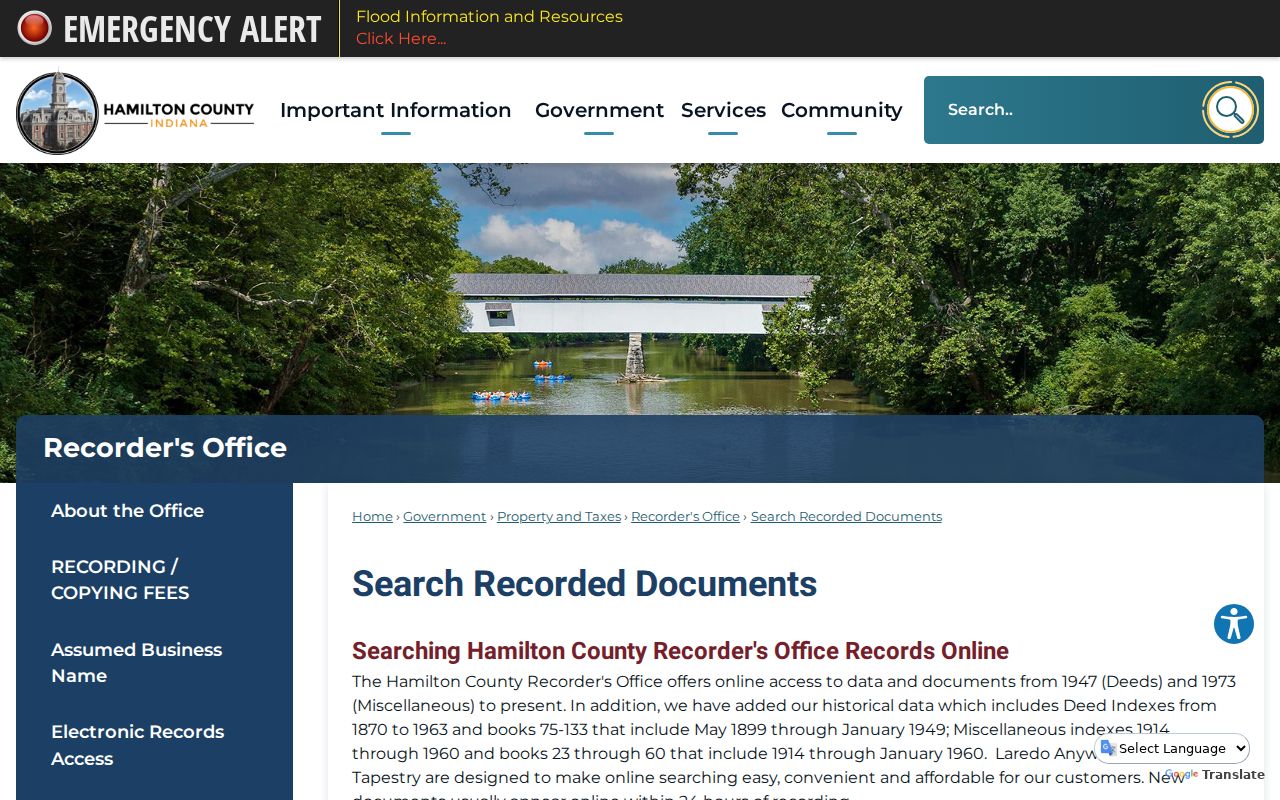
The county page distinguishes current Fidlar access from its historic index and book coverage.
Walk Hamilton's Grantor-Grantee Chain
Every deed names a giver and a receiver. Start with the current parcel report, then treat each grantor as the next name to search backward, since street addresses and parcel numbers change while the legal description holds. That description anchors the chain.
- Save the deeded owner, parcel numbers, legal description, subdivision and Last Recorded Date from Property Reports.
- Find the latest deed and verify that the current owner is the grantee on the same land description.
- Search the grantor as an earlier grantee, including initials, former names, trusts, entities, and capacity terms.
- Repeat through each conveyance, following any split, combination, replat, condominium declaration, or correction.
- Move to historic indexes, deed books, microfilm, or the in-office computers when online results end.
- Grantor
- The party conveying the stated interest.
- Grantee
- The party receiving that interest.
- Chain of title
- The linked sequence of instruments affecting ownership.
- Book/page
- A volume citation used especially for older records.
- Instrument number
- A unique recorded-document reference.
Historic Hamilton Deed Books
The Indiana State Library's Hamilton County microfilm guide lists 42 deed items. They span 1825 through 1901. Book A opens in 1825. Separate surname indexes span several overlapping periods. FamilySearch identifies courthouse deed records for 1825 through 1886.
One sequence skips letters and repeats 25 through 26. Do not repair that oddity from memory. Check the reel guide and the volume itself. Overlap can reflect separate index and book schedules rather than missing land records.
Note: The earliest online deed year is not the first year Hamilton County recorded land transfers.
Hamilton Fraud Alert Transition
Hamilton County changed its land-record search workflow and property-fraud alert system in 2025. Prior subscribers had to re-enroll through Property Fraud Alert. The free service sends an early notice whenever a subscribed name appears in a submitted recorded document.
An alert blocks nothing. It proves no fraud. Valid mortgages, releases, easements, corrections, and deeds can trigger it. Save the instrument number and image. Compare the legal description. Contact the Recorder before drawing any conclusion.
Obtain a Hamilton Deed Copy
Tapestry is the one-time route. County instructions list $8.75 per search and $1 per printed page, with results viewable without a separate document-view charge. Laredo Anywhere instead uses monthly minute packages, a signed agreement, recurring billing, and $1 printed pages. In-office public computers are open during Recorder search hours. Search hours end about ten minutes before closing.
Recorder staff provide access, not research or legal opinions. Once an instrument is identified, request it by instrument number, recorded date, indexed party, and legal description. The county warns that official recorded copies generally cost $1 per page and cautions against high-priced deed-copy mail solicitations.
The official Recorder office page lists the contact details.
The page outlines the office workflow for requesting a Hamilton County deed copy and notes the public-search limits that apply when online access is not enough.
Recorded, not guaranteed. Hamilton County deed records show accepted instruments, not a title opinion; court matters and unrecorded interests can require further review.
Hamilton Transfer Office Sequence
Every deed that transfers Hamilton County land moves through three offices in order. The Assessor examines the sales disclosure or its exemption first. Auditor Real Property next verifies the transfer and handles mapping. The Recorder accepts the instrument last and places it in the official deed records. County instructions ask for consistent grantee spelling. They also want the prior deed's legal description, notarization, the correct tax-mailing address, and the required disclosure form.
The Auditor charges $10 per parcel for the transfer. Its same-day cutoff is listed at 4:00 p.m. Office hours can change, so confirm before you go. Real Property also suggests an attorney or title company for drafting. Staff will not prepare legal instruments themselves.
Some chains drop out of the Recorder index entirely. Land passing through an estate, partition, foreclosure, court order, or trust administration often leaves deeds with a different custodian. The county notes that judgments, wills, decrees, and death certificates generally sit elsewhere. A recorded deed sometimes cites a case. Search the Hamilton County Clerk or Indiana MyCase. Then return to the instrument that applies the court's result to the parcel.
The legal description is the surest bridge across deed records. Street addresses change, and a split, combination, condominium declaration, or replat can shift parcel numbers. Record the subdivision, lot, section-township-range, acreage, instrument number, and recorded date at every step. A missed name search is not the end. Try initials, former surnames, trustee capacity, and entity suffixes. Also try correction deeds and re-recorded instruments before calling a chain incomplete.
Public computers remain a dependable fallback. Recorder search terminals are available until roughly 4:20 p.m. on weekdays. Staff will not run a title search for you. Bring names, date spans, legal descriptions, and any citations you hold. For a copy by mail, identify the instrument number and recorded date. The index supplies them first.