
Read Hamilton Property Tax Fields
The Hamilton County Property Reports and Payments portal combines assessment, deduction, statement, and payment panels in one place. Each field answers a distinct tax question. Save the tax record with its year attached, since values and relief can change.
| Field | What It Shows | Where |
|---|---|---|
| Gross assessed value | Land and improvement value before deductions | Assessor record |
| Deductions and credits | Named benefit, owner and year | Auditor roll |
| Net assessed value | Gross value after deductions | Tax report |
| Tax rate and liability | Rate, authorities, credits, caps and total | Tax statement |
| Payment details | Current balance and posted payments | Treasurer layer |
| Other assessments | Drainage, weed, sewage, unsafe-building or similar charges | Tax account |
Indiana assesses property at 100 percent of true tax value. The state calls this standard market value-in-use. That does not make a parcel's assessed value equal its latest sale price. A sale may be atypical. It might cover several parcels or include personal property. The sale could also fall outside the sales-study window. The tax bill then applies deductions and local calculations to the assessment.
Hamilton Tax Search Inputs
The county portal accepts four starting keys. An address search can work from a partial property address. A mailing-address search may return several parcels, so verify the legal description and both identifiers before opening a statement.
| Input | County guidance | Best check |
|---|---|---|
| County Duplicate Number | County labels a 16-digit input | Match the report heading |
| State Parcel Number | Help describes 18 digits | Do not substitute county format |
| Property Address | House number and partial street | Confirm situs and legal description |
| Mailing Address | Partial address accepted | Review each returned parcel |
The property search screenshot shows these separate choices.
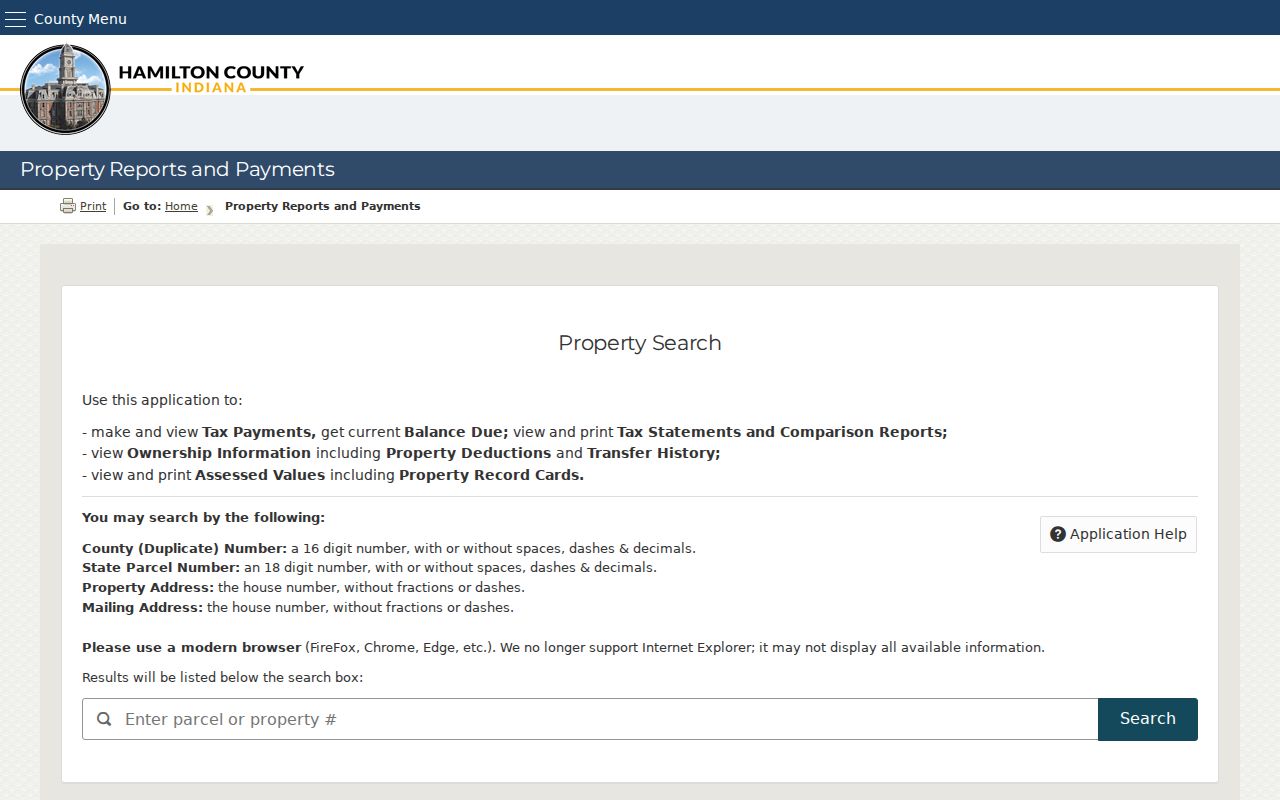
A state number in the county box yields nothing.
Three Years of Hamilton Statements
The property report displays three years of assessment results. It links to a Property Record Card. Tax Statements cover three years too. They are copies of statements as mailed. That means later corrections do not appear. Payment Details may therefore be more current than the statement.
From the card, save the land and improvement values, property class, and neighborhood. Also save acreage, building facts, deductions, and the assessment date. From the statement, save the taxing unit, due dates, rates, credits, and cap savings. Also record the authorities, total liability, and special charges. Online payments can take time. A just-made payment may need two to three business days to post.
Note: Compare records for the same tax year before treating a change as an error.
Look Up a Hamilton Tax Bill
A bill lookup starts at the parcel and ends at the live account. Keep the mailed statement as a fixed record. Then use current Payment Details for the balance due.
- Search Property Reports by address, county duplicate number, state parcel number, or mailing address.
- Confirm the situs, legal description, taxing unit, parcel number, and property-record type.
- Open the statement for the correct year, then compare it with current Payment Details and Other Assessments.
- Check Current Deductions and Credits by owner and year rather than assuming an old benefit remains.
- If delinquency appears, verify the live tax-sale list and account status with the Treasurer.
- Gross assessed value
- The county's value before deductions.
- Net assessed value
- Gross assessed value minus deductions.
- Tax rate
- The local rate applied within the taxing unit.
- Homestead deduction
- A year-specific benefit shown only when the record reflects it.
- Tax lien
- A claim tied to unpaid tax, distinct from a completed deed transfer.
Hamilton Deductions by Tax Year
The Current Deductions and Credits panel names each deduction or credit, its owner, and its year. Report what is shown. A prior homestead entry does not prove present eligibility, and an owner name on a deduction does not replace the deeded-owner check.
The Auditor handles deduction and transfer-roll questions. Assessment classification and property-characteristic disputes go to the Assessor. Payment posting and balance issues go to the Treasurer. A valid deed can coexist with an incorrect tax characteristic, so routing the problem to the right custodian saves time.
Hamilton Tax Sale Is Conditional
Hamilton County has scheduled a real-property tax sale for October 8, 2026, with the list expected around mid-August and a possible switch to a Zeus online auction. Sale, redemption, surplus, and minimum-bid status can change. Use the live tax-sale search by sale ID, property ID, address, ZIP, city, or taxing district. The official search page is the entry point. Check it before relying on any listing.
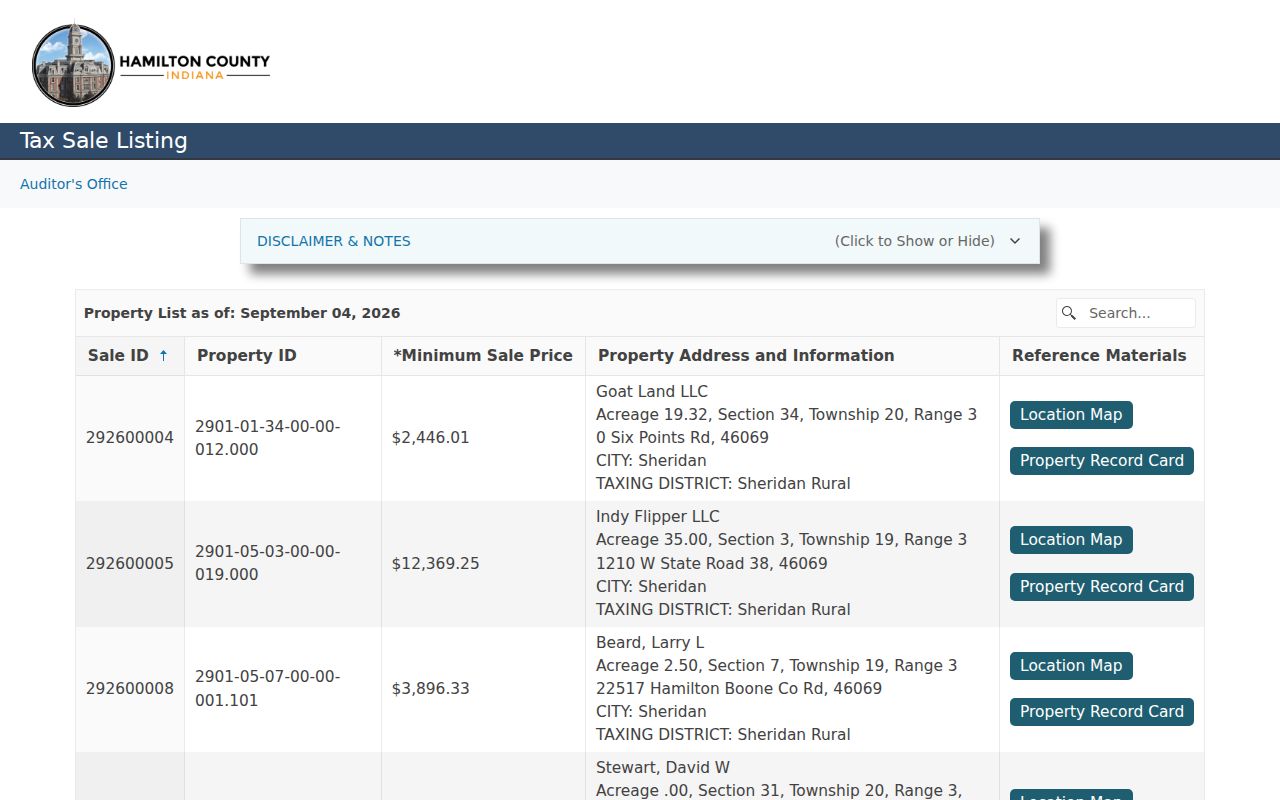
A listing shows a sale in process. It is not proof that a bidder already owns the parcel. The county warns that descriptions and status must be verified, and its tax-sale notice and process page supplies the changing calendar.
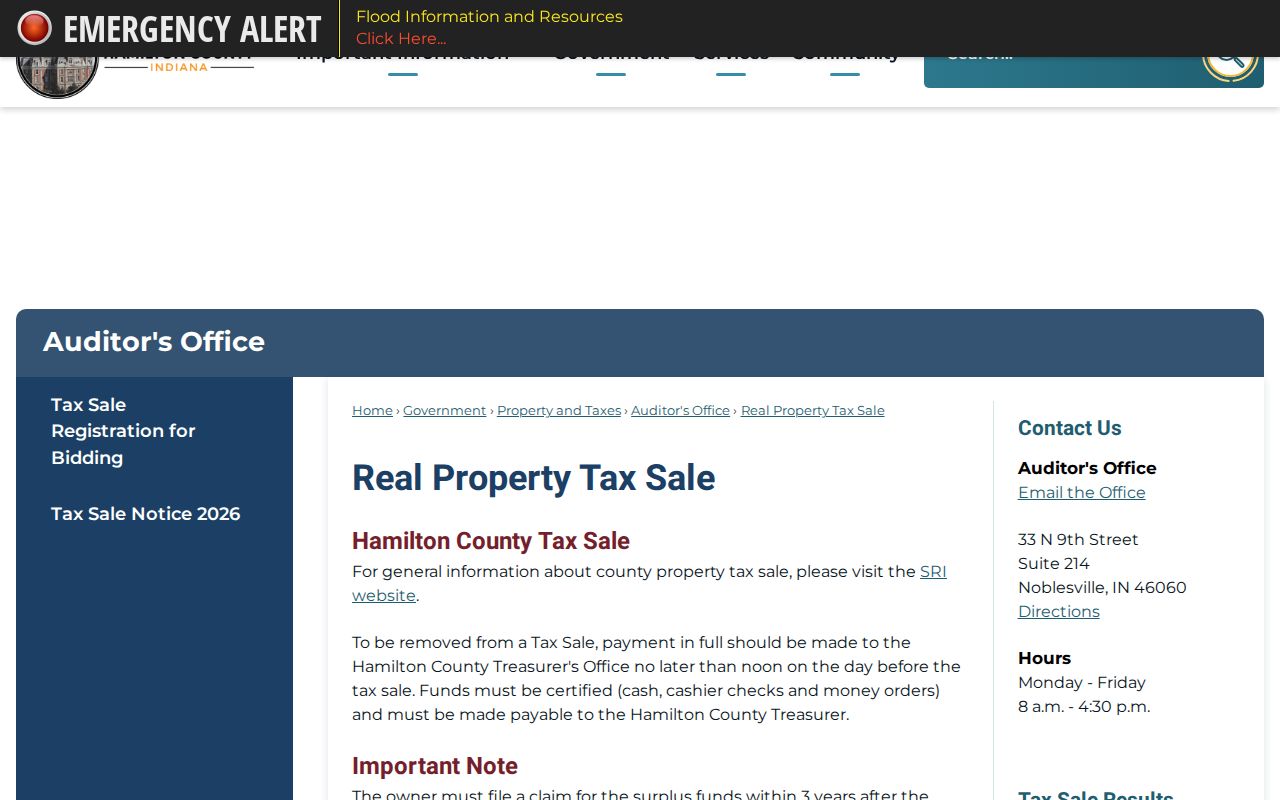
The notice separates tax-sale steps from sheriff sales and recorded deed ownership.
Hamilton Assessment Evidence
A useful assessment file includes Form 11, the Property Record Card, parcel identifiers, assessment date, land and improvement values, property class, neighborhood, building characteristics, comparable sales, measurements, photographs, permits, and evidence of condition or physical change. Comparable sales should match the study period. They should match the property type too.
The Assessor says the January 1, 2026 assessment uses sales from calendar year 2025. That annual window matters. A later sale may appear on a deed yet sit outside the study. Sales disclosure data can add reported consideration, acreage, class, neighborhood, tax district, and physical-change fields. It is not an appraisal.
Appeal a Hamilton Assessment
The current county appeal process lists June 15, 2026 as the deadline for the 2026 assessment. Form 11 notices are mailed by April 30. The page offers an online Form 130 route and describes a power-of-attorney requirement. Use the live cycle page. An archived deadline may not apply.
An appeal challenges value or classification. It does not fix a deed, deduction, or payment, so identify the error, attach evidence that speaks to it, and preserve proof of filing and every response.
Appeal window. Hamilton County lists June 15, 2026 for the current assessment cycle; verify the live deadline before filing Form 130.
Hamilton Tax Record Limits
A tax bill proves certain things and not others. It documents assessed amounts, relief, rates, liabilities, charges, and payment status. It cannot establish clear title. It cannot settle a legal boundary or fix an open-market sale value. A low liability may reflect credits or caps. A high balance may instead include delinquency or a special assessment. Read the fields before drawing conclusions.
Some records never appear online. When that happens, ask the office that keeps the record itself. The Assessor holds assessment evidence. The Auditor maintains the roll and deduction data, while the Treasurer handles collection. An Indiana Access to Public Records Act request works best when it names the specific existing record. Name the preferred copy format too. No office is obligated to build a custom tax analysis.
The sample county tax statement shows why year labels matter so much. It lists parcel and property identifiers, the legal description, taxing unit, property-record type, installment dates, land and improvement assessments, deductions, rates, taxing authorities, credits, and other charges. Treat that field inventory as a map of what a real bill contains. Do not treat the sample as anyone's live balance.
Payment disputes call for a current account check. Online payments can post with a delay. Card and e-check transactions carry separate convenience charges. Confirm live payment instructions before any transaction. A mailed statement may stay unchanged after a correction, while the Payment Details screen reflects a later event. Save both versions rather than overwriting one with the other.